
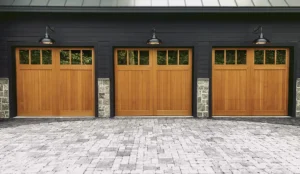
 Customized Garage Doors
The Garage Door That Changes Everything
The most expensive house on your street…
…can still be ruined by a cheap garage door.
You’ve probably seen it.
Architect-designed facade. Custom windows. Perfect landscaping.
And then… a big, flat, fake-wood rectangle bolted onto the front of the house.
It’s like someone wore a tailored suit… and Crocs.
Here’s the strange part:
That giant, boring rectangle?
It usually makes up 30–40% of the entire front elevation of the home.
Which means one simple thing:
If you get the garage door wrong, nothing else gets to shine.
If you get it right, the whole house suddenly looks more expensive. Instantly.
(You already know this, by the way. That’s why you’re here. Something about your current door has been bugging you for months.)
“We did everything… except the part everyone sees first.”
Let me tell you about one of our clients, Emma.
Emma and her partner spent two years designing their dream home.
Architect. Interior designer. Custom cabinetry. European appliances. The works.
The day they moved in, the neighbor walked over, glass of wine in hand, and said:
“Wow, looks great! Are you going to upgrade the garage door later?”
That one sentence hit harder than the entire build budget.
Because Emma knew he was right.
The architect had meticulously obsessed over every line of the facade…
and then the builder threw in a “standard panel door, wood-look” at the end.
(It was technically “fine.” It was also visually shouting: spec home.)
Fast-forward three months.
Same neighbor. Same glass of wine.
Same driveway.
Different door.
This time he didn’t say anything at first. Just stood there. Looked. Took another step back.
“Okay. Now it looks like one of those houses.”
That’s the moment Emma told me she finally felt the house was finished.
Not when the last tile went in.
Not when the sofa arrived.
But when the garage door stopped looking like an afterthought.
Customized garage doors aren’t about “fancy.” They’re about silence.
Here’s a belief I operate from:
Truly high-end things rarely scream.
They whisper.
A luxury garage door doesn’t need fake carriage hardware or big decorative hinges.
(It definitely doesn’t need a faux “barn” X glued on the front.)
It needs three things instead:
-
Correct proportion.
The lines of the door must extend the architecture of the house, not fight it.
Horizontal slats that match the window mullions. Glass sections that line up with transoms.
When it’s right, your eye slides over the facade without catching. It just feels… calm. -
Material honesty.
If it looks like wood, it should either be wood, or be very clear that it’s a deliberate, modern interpretation.
Real timber with a vertical grain that continues from cladding to door.
Or powder-coated aluminum with glass, openly modern. No pretending. -
Quiet performance.
Not just “doesn’t squeak.”
I mean the rollers gliding in the track so smoothly you can hear the slightest shift in air pressure as the seals close.
The insulated panels catching that last echo of street noise and swallowing it.
(You might not think you care about this. Until you stand under a door that feels like a vault closing with a soft thunk instead of a clattering rattle from 1997.)
The molecule-level difference (this is where “high-end” actually lives)
Let’s zoom all the way in for a moment.
Take a typical, builder-grade steel door.
Two thin sheets of metal. A hollow cavity. Basic springs. Standard track.
When it closes, air leaks in around the edges. Heat leaks out through the panels.
Every time the motor pulls, micro-vibrations travel down into the tracks and up into the framing.
You feel it in your bones more than you hear it. A faint shudder.
Now compare that to a door built the way we insist on doing it:
-
Panels with dense insulation inside.
(Tiny gas pockets inside the core slow down heat transfer, molecule by molecule.) -
Extruded aluminum frame or engineered timber that doesn’t twist with the seasons.
(The lattice of fibers or metal crystals stays aligned; the panel doesn’t bow, so gaskets can actually seal.) -
Flexible seals that compress just enough as the door meets the ground.
They push back against the slab, closing off those invisible pathways where dust, cold, and exhaust fumes sneak in.
You don’t see any of this from the street.
But your nervous system feels it when you come home on a windy night and the garage is still, warm, and quiet.
Your power bill feels it over the years.
And buyers feel it when they touch the door and subconsciously register: This is solid.
That’s the difference between “nice upgrade” and “this house was clearly built on another level.”
Who this is (DEFINITELY) for
Let’s be honest.
If you just want “a new door that kind of looks like the one next door but slightly less ugly,”
there are a hundred companies who will happily do that for you.
We’re not one of them.
We’re for you if:
-
You’ve already done the architect, the landscaping, the lighting…
and the garage is the one piece that still feels wrong. -
You care about how the inside of the garage feels, not just how the outside looks.
(Because your garage is a gym, studio, or the place you actually walk through every single day.) -
You look at full-view glass, timber slats, or minimalist flush panels and think,
Yes. That. But tailored to this exact house.
You don’t have to know what’s possible yet.
That’s my job.
You just have to know you’re done with the default options.
“But is it really worth it? It’s just a garage door.”
This is the voice of your inner accountant talking.
It’s not wrong to ask the question.
So let’s answer it, briefly.
Real estate agents will tell you: the front elevation sells the house.
People decide how they feel about a property in about seven seconds.
In those seven seconds, your garage door is doing more work than your front door, your roof, and your landscaping combined.
It’s the single largest moving object on your home.
Upgrading that one element does three things at once:
-
Curb appeal jump.
Your house stops blending into the street. It starts looking like the house on the street. -
Daily experience upgrade.
Every time you leave and arrive, you feel the difference. The light, the quiet, the solidity. -
Resale proofing.
Even if you have zero intention of selling now, you’ve removed the “we’ll need to replace that door” objection from the future buyer’s mind.
And yes, we’ll talk specifics. Materials. Lifespan. Cost ranges.
(That’s coming a bit later, when you’re not still trying to decide if this is even worth thinking about.)
For now, just notice this:
Your mind has already upgraded the door in your head.
You can almost see it, can’t you?
What happens when we work together
Here’s how this usually goes.
First, we look at your house the way an architect would.
Not “choose a door from our catalog.”
But: What does this facade want?
We’ll look at:
-
The lines of your windows and cladding.
-
The direction of your light.
-
How your roof overhang frames the opening.
-
The colors and textures already in play.
Then we sketch a few directions.
One might be a full-view glass and aluminum composition that turns the garage into a glowing lantern at night.
Another might be a timber-look or real-timber design with slim, shadow-line slats that echo your entry door.
A third might be an almost invisible, flush system where the garage door disappears into the wall.
(We’ll get into examples and real projects on the next page. That’s where it starts to get dangerously inspiring.)
Once we’ve aligned on the concept, we drop down a level:
Hardware. Tracks. Motor. Safety. Insulation ratings.
We engineer a system that feels luxurious but works every single day without drama.
My quiet, slightly obsessive goal?
That five years from now, you still smile a tiny bit every time your door opens.
Before we go deeper… a small warning
Spending time on the next page is risky.
Because once you see what’s actually possible with a high-end garage door
— the transformations, the “before/after” facades, the way a single opening can change the whole personality of a home —
it becomes very hard to live with what you have now.
So, if you’re okay with that:
Click through to “Design Stories & Gallery.”
That’s where I’ll show you:
-
The exact design that turned Emma’s “spec home” facade into an architectural statement.
-
How we used glass, shadow, and proportion to make a narrow home look wider.
-
And the one subtle detail we add to certain doors that makes visitors assume your house cost at least 20% more than it did.
(Once you’ve seen those stories, you’ll never look at a plain white panel door the same way again.) Check our our next article for you to read.